Showing posts with label World Wide Web. Show all posts

2.13.2013

The catfish gutted: Social media, virtual relationships and identity fraud


When his documentary Catfish was released in 2010, Nev Schulman was a 26-year-old, relatively unknown photographer from New York. Since the production of the movie’s television counterpart on MTV in 2012, he has become a sort of benevolent relative of To Catch A Predator’s Chris Hansen, busting not chat room pedophiles but instead, dishonest online daters.

Catfish the TV show is a half exposé, half humanitarian effort that feasts on the premise of physically uniting people who have, until that point, kept their romance confined to the Internet. In Catfish the documentary, Nev traveled to meet Megan, who he had been carrying on a relationship with solely via Facebook, phone calls, and text messages. Young, beautiful Megan proved to actually be a ruse identity for not-so-young, not-as-beautiful Angela. It was revealed that Angela assumed many online personas, utilizing Facebook sort of like The Sims. She gave life to Megan by creating elaborate storylines and friends for her to interact with on her Facebook wall. It was a complex web of lies that Nev found himself in, and his obvious solution was to capitalize on this newly identified phenomenon of “catfishing.”

According to UrbanDictionarya catfish is "someone who pretends to be someone they're not using Facebook or other social media to create false identities." Nev claims to have created Catfish the TV show as a way for people in this uniquely 21st century situation to discover the truth—or perhaps, to shed their naïveté and move on to relationships with physical, tangible, verifiable people. The series begs the question: Does anyone ever truly have hope that his or her situation won’t have a result similar to Nev’s? Do these guys really believe they are in an online relationship with a gorgeous model that is too busy to meet up for one, two, or ten years, but strangely has no evidence of any modeling gigs? Are they actively ignoring what is blatantly fishy, or has the desperation for a connection rendered them oblivious to a barrage of crimson red flags?
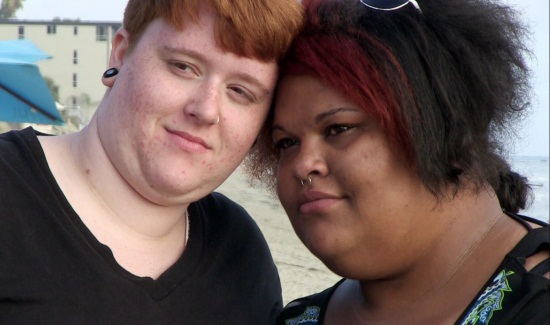
"Alyx" and Kya, a rare Season One Catfish success story.
The TV show has so far aired ten episodes, only two of which have resulted in a tangible, offline relationship. The show is well-accomplished at enforcing the strength of an artificial connection and the comfort of delusion, having proven more times than not that honesty ruins whatever semblance of a relationship once shared in a world where lovers have no webcam, eternally poor cell phone service, and only six photos of themselves. When the all-American jock learns that he has been talking to a gay African-American man for over a year instead of “some super sexy farmer’s daughter,” the implied silver lining is the catfish’s awakening and acknowledgment of identity crisis, and the expected friendship that will blossom from newly planted soils of truth. However, it becomes quite apparent that any understanding or sympathy for the perpetrator is crushed under the weight of disappointment – the relationship was too good to be true, and it was indeed untrue. All the thoughts and feelings they believed to have expressed to someone they were physically attracted to, were actually fed to a person that is now tantamount to a trashcan – words and time wasted, never to be recouped. Frequently, the emotional or mental connection that has e-stimulated the catfishee for so long is thwarted into a fine dust once they realize they’ve been duped. There is very little way to forge meaningful relationships on fraudulent grounds – oh, unless the physical attraction is real, of course (as seen in the Rico and Jamari episode). And the physical attraction is quite often absent, or rather, one-sided in these situations. The catfish cites fear of rejection as justification for what they’ve done, usually to then be rejected.

The people who catfish seem to have a few things in common – according to the show, at least. They are confused about the space they occupy in the dating world, often struggling to come to grips with difficult sexual preferences or self-confidence—or both.

Collin* has been catfishing for about 10 years, since he was 14 – and has never seen either the movie or the show.

“I started in ninth grade,” he said. “My situation was that I [am] gay and was infatuated with a lot of my [straight male] friends, and the only way I could get the type of intimacy I wanted from them was to create this girl.”

Collin created a persona who used the name Janice, using either unknown girls’ photos taken from the Internet, or photos of one of his childhood friends. He contacted several dozen of his classmates under the guise of Janice over a span of years, and even went as far as speaking to and engaging in phone sex with some of them, changing his voice.

“I did it purely out of lust,” said Collin. “I would never go as far as to say ‘I love you’ or want a relationship with them. This is completely separate from my love life.”

Catfish hoax victim Manti Te'o.
Indeed, the Internet may at first appear to be a promising resource for those looking for a romantic connection: contact with virtually anyone is merely a click away.  With whom we are actually connecting is a separate and much bigger issue. Notre Dame football player Manti Te’o was recently the victim of a catfish hoax, believing he was dating a woman named Lennay Kekua, who actually was a persona created and operated by a man claiming to have been in love with him, Ronaiah Tuisosopo.

“The Te’o thing is hard to grasp,” Collin said. “How can you be in love with somebody and they think you’re someone else? How do you process someone loving you, when it’s not you that they love?”

The psychology behind catfishing appears complex, but in a large part fueled by confusion and some brand of self-doubt. This is an obvious observation, reiterated by the comment most frequently spewed by catfishers upon first meeting their catfishee: “I was scared to tell the truth, I thought you might stop talking to me.” For most people, pixels will never adequately replace a person, so it is not farfetched to surmise that this population of online-only daters has something to hide, whether it be an element of their identity or their entire selves altogether. The contemporary nature of social interaction allows for such concealment—catfishing could not have been possible before the boom of the Internet. On the other hand, growing online presence—more people on more platforms—make it increasingly difficult to successfully carry out a catfishing operation. Collin recalls being caught in his scheme when he was chatting with someone who found the pictures he sent, online on its actual profile. On the TV show, simple Google image searches often reveal that the pictures of the supposed love interest actually belong to someone else. From that point forth, it is at best naïve to believe that the rest of the story unfolds like a fairy tale.

Collin believes that online dating and communication in general can be very shady in nature, and believes the fault lies in the person that willingly talks to a stranger and raises no suspicion. For him, the best defense is common sense.

“I don’t know why you would continue talking to someone you’ve never seen, someone who always has an excuse for why they can’t chat with you on a webcam,” Collin said. “I personally don’t think I would ever fall for something like that.”

*Name has been changed.

5.27.2012

What's in a "like"?


Posting a photo to Instagram is almost meaningless without the hopeful slew of "likes" that follow shortly thereafter. You've taken a share-worthy picture, selected a befitting filter, and have bared all for the Instaworld to see. 63 likes is certainly a better feeling than 12. 1,253 likes will get you to the "Popular" page. But what does it all mean? In short, nothing.

The culture of the "like" is one that has only recently emerged. It is a descendant of other rating methods: think the 5-star movie rating system by which we rate our cinema. On Facebook and Instagram we can "like" something as an instantaneous sign of approval and wordless compliment. On YouTube or Reddit, it's taken a step farther, where you can express your dislike, as well, with one click of a button. On Twitter and Tumblr, admiration can also be expressed in the "most flattering" way: imitation—a retweet or a reblog, respectively.

In an ideal world, the frequency of a like would be an accurate way to measure an item's popularity, success, or overall appeal. However, as we also consider other factors, the integrity of the like seems to shift. Rihanna posts a picture of her left ear and instantly is flooded with 20,000 likes. A talented yet relatively unknown photographer shares an important shot and is social media invisible.

There is a philosophy behind the like, and a burgeoning online culture that surrounds it. It can be utilized as an icebreaker, the like acting as a virtual introduction, a way of making friends via social networking. It can also garner jealousy and distrust between social media butterflies involved in intimate partnerships in the non-pixelated world. The meaning of a like depends on what was liked, and why one liked it. Liking a status that proclaims today has been the worst day in history is spiteful. Liking a status that reads "I'm officially a [name of college of university] graduate!" is universal and customary. We also must consider the frequency with which one reaches for the like button. If someone likes everything, it begins to mean less. If a person has (obviously) viewed every picture you've ever posted, and liked only one from 7 weeks ago, then, well, they must genuinely like that photo a lot.

It's impossible to read too much into the like, as it is just a simple, staple function of most social media networking platforms employed to engage users with one another's personal content. It can be flattering, it can be ironic, it can be annoying. Wherever the root of the like lay, it is arguably the simplest form of contemporary camaraderie.