2.13.2013

The catfish gutted: Social media, virtual relationships and identity fraud


When his documentary Catfish was released in 2010, Nev Schulman was a 26-year-old, relatively unknown photographer from New York. Since the production of the movie’s television counterpart on MTV in 2012, he has become a sort of benevolent relative of To Catch A Predator’s Chris Hansen, busting not chat room pedophiles but instead, dishonest online daters.

Catfish the TV show is a half exposé, half humanitarian effort that feasts on the premise of physically uniting people who have, until that point, kept their romance confined to the Internet. In Catfish the documentary, Nev traveled to meet Megan, who he had been carrying on a relationship with solely via Facebook, phone calls, and text messages. Young, beautiful Megan proved to actually be a ruse identity for not-so-young, not-as-beautiful Angela. It was revealed that Angela assumed many online personas, utilizing Facebook sort of like The Sims. She gave life to Megan by creating elaborate storylines and friends for her to interact with on her Facebook wall. It was a complex web of lies that Nev found himself in, and his obvious solution was to capitalize on this newly identified phenomenon of “catfishing.”

According to UrbanDictionary, a catfish is "someone who pretends to be someone they're not using Facebook or other social media to create false identities." Nev claims to have created Catfish the TV show as a way for people in this uniquely 21st century situation to discover the truth—or perhaps, to shed their naïveté and move on to relationships with physical, tangible, verifiable people. The series begs the question: Does anyone ever truly have hope that his or her situation won’t have a result similar to Nev’s? Do these guys really believe they are in an online relationship with a gorgeous model that is too busy to meet up for one, two, or ten years, but strangely has no evidence of any modeling gigs? Are they actively ignoring what is blatantly fishy, or has the desperation for a connection rendered them oblivious to a barrage of crimson red flags?
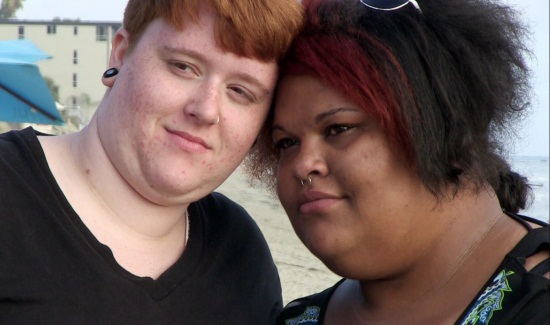
"Alyx" and Kya, a rare Season One Catfish success story.
The TV show has so far aired ten episodes, only two of which have resulted in a tangible, offline relationship. The show is well-accomplished at enforcing the strength of an artificial connection and the comfort of delusion, having proven more times than not that honesty ruins whatever semblance of a relationship once shared in a world where lovers have no webcam, eternally poor cell phone service, and only six photos of themselves. When the all-American jock learns that he has been talking to a gay African-American man for over a year instead of “some super sexy farmer’s daughter,” the implied silver lining is the catfish’s awakening and acknowledgment of identity crisis, and the expected friendship that will blossom from newly planted soils of truth. However, it becomes quite apparent that any understanding or sympathy for the perpetrator is crushed under the weight of disappointment – the relationship was too good to be true, and it was indeed untrue. All the thoughts and feelings they believed to have expressed to someone they were physically attracted to, were actually fed to a person that is now tantamount to a trashcan – words and time wasted, never to be recouped. Frequently, the emotional or mental connection that has e-stimulated the catfishee for so long is thwarted into a fine dust once they realize they’ve been duped. There is very little way to forge meaningful relationships on fraudulent grounds – oh, unless the physical attraction is real, of course (as seen in the Rico and Jamari episode). And the physical attraction is quite often absent, or rather, one-sided in these situations. The catfish cites fear of rejection as justification for what they’ve done, usually to then be rejected.

The people who catfish seem to have a few things in common – according to the show, at least. They are confused about the space they occupy in the dating world, often struggling to come to grips with difficult sexual preferences or self-confidence—or both.

Collin* has been catfishing for about 10 years, since he was 14 – and has never seen either the movie or the show.

“I started in ninth grade,” he said. “My situation was that I [am] gay and was infatuated with a lot of my [straight male] friends, and the only way I could get the type of intimacy I wanted from them was to create this girl.”

Collin created a persona who used the name Janice, using either unknown girls’ photos taken from the Internet, or photos of one of his childhood friends. He contacted several dozen of his classmates under the guise of Janice over a span of years, and even went as far as speaking to and engaging in phone sex with some of them, changing his voice.

“I did it purely out of lust,” said Collin. “I would never go as far as to say ‘I love you’ or want a relationship with them. This is completely separate from my love life.”

Catfish hoax victim Manti Te'o.
Indeed, the Internet may at first appear to be a promising resource for those looking for a romantic connection: contact with virtually anyone is merely a click away.  With whom we are actually connecting is a separate and much bigger issue. Notre Dame football player Manti Te’o was recently the victim of a catfish hoax, believing he was dating a woman named Lennay Kekua, who actually was a persona created and operated by a man claiming to have been in love with him, Ronaiah Tuisosopo.

“The Te’o thing is hard to grasp,” Collin said. “How can you be in love with somebody and they think you’re someone else? How do you process someone loving you, when it’s not you that they love?”

The psychology behind catfishing appears complex, but in a large part fueled by confusion and some brand of self-doubt. This is an obvious observation, reiterated by the comment most frequently spewed by catfishers upon first meeting their catfishee: “I was scared to tell the truth, I thought you might stop talking to me.” For most people, pixels will never adequately replace a person, so it is not farfetched to surmise that this population of online-only daters has something to hide, whether it be an element of their identity or their entire selves altogether. The contemporary nature of social interaction allows for such concealment—catfishing could not have been possible before the boom of the Internet. On the other hand, growing online presence—more people on more platforms—make it increasingly difficult to successfully carry out a catfishing operation. Collin recalls being caught in his scheme when he was chatting with someone who found the pictures he sent, online on its actual profile. On the TV show, simple Google image searches often reveal that the pictures of the supposed love interest actually belong to someone else. From that point forth, it is at best naïve to believe that the rest of the story unfolds like a fairy tale.

Collin believes that online dating and communication in general can be very shady in nature, and believes the fault lies in the person that willingly talks to a stranger and raises no suspicion. For him, the best defense is common sense.

“I don’t know why you would continue talking to someone you’ve never seen, someone who always has an excuse for why they can’t chat with you on a webcam,” Collin said. “I personally don’t think I would ever fall for something like that.”

*Name has been changed.

1.07.2013

A beginner's quasi-Christian response to the Bible

"All living souls welcome whatever they are ready to cope with; all else they ignore, or pronounce to be monstrous and wrong, or deny to be possible."
 - George Santayana 

"You've gotta take this thing with a grain of salt, buddy, come on." 
- Reverend Lovejoy on the bible, The Simpsons

I’ve never considered myself religious. I’ve managed to avoid actually reading the Bible for all of my 23 years, perhaps because I’ve been intimidated by the reputation that precedes it. It toted a sort of Pandora’s box-like quality that I simply sidestepped until a few weeks ago, when out of sheer curiosity an organic interest was born in me. In some way, religious or secular, personally or academically, I knew I would be a disadvantaged bibliophile if I continued to judge this revered book by its bland, monochromatic cover. So, like planet Earth, I started with Genesis.

While a 2011 Gallup survey reports that a whopping 30 per cent of U.S. adults interpret the Bible literally, I am siding with the majority. After all, subjugation of women, religious intolerance, incest, slavery, and capital punishment are all societal woes that are justified in the Bible. Just how seriously can we treat questionable biblical guidance while retaining practicality and sanity? 

Certainly, God would not want us to kill two turtledoves every time we sinned. Are there even enough turtledoves alive to accommodate that? And surely God would not literally want us to cut off the hand that we’ve used to sin—we’d be a legion of amputees. We widely ignore specific counsel regarding premarital sex (1 Thessalonians 4:3-5), ejaculation (Genesis 38:9), divorce (Matthew 19:6), and finances (1 Corinthians 16:2). If some things in the Bible can be so casually and commonly overlooked, how can other things be so fiercely guarded and debated?

God said that it was an abomination for a man to lie with another man (Leviticus 20:13)—and this has spiraled into a culture of institutionalized homophobia. God told us to give 10 per cent of our income to the church (Leviticus 27:30)—and now we have churches with billboards and commercials, the pastor wearing a mic like Britney Spears’, and toting a salary that rivals hers. God told us to be fruitful and multiply (Genesis 9:7), and now we have blanketed the Earth with our presence, much to its detriment. Would it not be wise to treat all people as equals, tithe directly to charities and those we wish to help, and assign more focus towards cherishing and preserving the earth we have been multiplying upon?

Throughout my reading, one question plagued my mind worse than frogs or locusts: Why is it that we are so afraid to admit that we do not know something? We would rather create answers with gaping inconsistencies than to conclude we do not and cannot know, because to admit that is to introduce the possibility that nothing is real. Nothing exists the way we believe it does, so why should the truth, whatever that may be, mirror our hypotheses? Why should the reality of what will become of us be within the spectrum of our abilities to understand and comprehend life and death?

I don’t know if I became a journalist because I am skeptical, or if I am skeptical because I am a journalist. I constantly find myself questioning articles that I read from even the most “reputable” sources. My general skepticism has certainly prevented the progression of any personal relationship I might have with religion, or more specifically, Christianity. A compilation of tales written by ancient strangers, who certainly were much different than I in language, lifestyle, and frame of intelligence, won’t win my trust with just the shake of a shekel.

I do not believe circumcision is a prerequisite for holiness. I do not believe God “hates fags,” as religious picketers tend to boast. I do not believe the Israelites are the favored people of Earth. I find that unjust and unlike a God that is purported to love everyone equally. In fact, in 1999, Tel Aviv University archaeologist Ze’ev Herzog said in an article in the Ha’aretz newspaper that “the Israelites were never in Egypt, did not wander in the desert, did not conquer the land in a military campaign and did not pass it on to the 12 tribes of Israel.” Furthermore, Herzog asserts that “the united monarchy of David and Solomon, which is described by the Bible as a regional power, was at most a small tribal kingdom.”

Though Herzog’s statements remain controversial, they are a quintessential representation of the intent of biblical archaeology: to sift the true apart from the false. The basis for so much conflict that bleeds into the history we are today writing is mythical. As we forge battles on archaic beliefs, we curtail the opportunities for internal progression and ultimately, peace. Though we pick and choose biblical logic to support our moral standpoints, there will almost always be other biblical content to the contrary. Therefore, perhaps the situation is akin to lawyers arguing a complicated legal case. No one is wrong, no one is right, but the implications are widespread enough to affect us all. The challenge is utilizing the contents of the Bible as a tool and not a weapon.

No one can deny that there is more to life than we know. There is more to everything that we see, that we feel, that we shallowly surmise based on this book or that experience or this friend or that teacher. Our existence is entirely our own, and it only makes sense that many would feel motivated to invite in a higher power, a source of hope, a way to justify our existence as something more than a blip in the universe. I look out into the galaxy and feel compounded by the weight of all of which I do not know, which no one knows, and no one may ever know. You cannot convince someone to relinquish their faith, because to their faith they are indeed faithful. I just only hope for this faith to culminate in positive and progressive ways, and not revert to archaic ideologies of intolerance and hateful violence.

Everyone who believes anything that cannot be proven is doing so for their own reasons, all of which may differ from one another. Some believe to be protected, some believe because they have been bred into believers. Some believe because they genuinely believe, and others believe because they’ve never given a second thought to what it is they actually believe and why. The strongest argument I have heard for being a “person of faith” is that believing gives you nothing to lose and everything to gain, while disbelieving gives you everything to lose and nothing to gain.

However, I am more impressed with the contemplative than the assured, whether that’s assurance in theism or its opposite. Life is a journey with no finite answers, no technical guidebook to steer you—though I’m sure the Bible was the biggest and most successful attempt. The ability to have an open mind and genuinely consider the possibility of different truths and realities is paramount to progression as a person. It might not secure your admission into those pearly gates, if you believe a Heaven exists, but at least on Earth your aura will shine bright in a secular light.

12.01.2012

Domestic violence and the domino effect of decisions, especially if you're Rihanna


Police photo of Rihanna following the assault on Feb. 8, 2009.
Just after midnight on February 8, 2009, pop superstar Rihanna and then-boyfriend Chris Brown inked a shameful page of pop culture history, the story indelibly summed up with the now-infamous police photo of Rihanna’s bruised and bloodied face, courtesy of Brown’s bad temper.

Nearly four years have passed since Brown was charged with assaulting Rihanna viciously in his car, and the two have gradually shed concern about hiding their persisting romantic connection. One visit to the Bajan singer’s Instagram reveals just how close they are, with the two entertainers’ private moments shared, ever so casually, with Rihanna’s nearly four million followers.

Unlike most domestic violence victims, Rihanna’s plight was witnessed by the world, as was her return to the partner who hit her. Rihanna is a high-profile reflection of innumerable women facing difficult decisions—except, unlike many other women, nothing is pinning her to Chris Brown aside from her own desire. Rihanna is not financially dependent on Brown, or any other person for that matter. They have no kids, and certainly no marriage. She’s gorgeous, talented, and wealthy. If she chooses to publicly embrace a person who once reduced her face to a series of gashes and welts essentially in front of the entire world, then to younger, more naïve, and less affluent people with fewer resources—what’s the occasional slap or shove?

What Rihanna is saying, quite effectively albeit unintentionally, is that despite boundless resources and unrelenting support, sometimes a person will still return to the arms of the one that’s hurt them. Or in Rihanna’s case, one that’s repeatedly and mercilessly punched them in the face, causing their mouth to fill with blood.

Rihanna in an interview with Oprah Winfrey.
In an interview with Oprah Winfrey earlier this year, Rihanna explained how she strangely felt protective over Brown after he assaulted her. “He made that mistake because he needed help, but who’s going to help him?” the singer tearfully asked on the special that aired August 19. “I was hurt the most. Nobody felt what I felt.”

That solipsistic outlook is something that 23-year-old Vanessa*, who is just one year younger than Rihanna, was no stranger to. In 2009, at the time that the singer’s battered face became etched in society’s collective psyche, Vanessa had been dating Tim* for almost two years.

“He was very handsome and very sweet when I first met him,” said Vanessa, who was 17 at the time. He was 21. She was enraptured by his beautiful teeth and by the fact that he owned his own car. After they began dating, the sweetness soon dissipated into acts of rage and irrationality. About six months into their relationship, Tim found a photo of himself in Vanessa’s car and became furious. He accused her of wanting to put pictures of him on the Internet, something he was vehemently against—because he was maintaining other romantic relationships as well, Vanessa later found out.

“He balled the picture up, threw it in my face, then picked it back up and shoved it in my mouth,” Vanessa said. “I kind of overlooked [the incident] because I was afraid. It was just too weird.”

Tim was not apologetic, either. His response to the incident: “Don’t have pictures of me and it won’t happen again.”

Though she never snapped another photo of Tim, it did happen again, most severely on Valentine’s Day of 2010. “Snowpocalypse” was ravaging the East coast, and Tim’s car became stuck while parked outside of Vanessa’s house, which he adamantly blamed on her. He demanded that she get his car out, and after attempting to dig his car out of several inches of snow and ice for an hour, Vanessa gave up. When she returned inside, he accosted her in the kitchen and choked her. She ran upstairs to lock herself in her bedroom, but he pursued, and the situation was eventually “settled” with sex.

Vanessa also recalled a situation where she accidentally knocked a lollipop out of Tim’s mouth, and he immediately slapped her in the face. She says the physical aggression was few and far between, making it even harder to pinpoint the exact moment she’d let go and leave.

There was no breaking point, no one moment that pushed Vanessa over the edge. She gradually cut off all romantic ties with Tim on her own accord, simply deciding that his positive qualities, if any, were not enough to justify the ugly ones.

“I think there’s this attitude where you accept something because you think it’s how it’s supposed to be,” Vanessa said. The irony is that Vanessa still maintains a casual friendship with Tim, who shares similarly unsettling details of his new relationships with her. His despicable actions are never addressed, and his continuing to casually behave the same way is either a statement of obliviousness or complete disinterest.

As with Tim’s response to his aggression, Brown’s collective response to his assault of Rihanna, particularly to critics, has been one of flippancy and disrespect. The public apology he issued post-incident is hardly an indicator of his remorse, as his actions are speaking far louder.

Unsavory publicity seems to have become a staple of Brown’s career: angrily bashing windows at daytime talk shows, getting the face of a beaten woman tattooed on his neck, participating in bafflingly immature and sexist Twitter arguments. He is by most accounts uncouth, and, to borrow from Rihanna’s latest album, unapologetic. After Rihanna’s emotional interview with Oprah, Brown’s response in so many words: That’s old news, so stop crying about it.

Chris Brown does not present himself as a good person, and furthermore, shows no sign of a behavioral metamorphosis. Rihanna’s insistence on affiliating with him is damaging and dismissive, and makes a huge statement about how women are encouraged or expected to respond to domestic turbulence.

After all, Vanessa’s face never looked anything like Rihanna’s on the night of February 8. 

The physical, outward toll of the abuse Vanessa experienced over the course of a few years paled in comparison to Rihanna’s one brush with domestic violence, and it is strangely understandable how someone in her situation may choose to stick around despite red flags.

Rihanna and Chris Brown photographed at a club in Sept. 2012.

The men who are domestic violence perpetrators will likely always behave the same way, either because they do not know or choose not to know that it is a huge problem. Many of these men have cemented abusive behaviors as the norms in their lives, possibly having witnessed similar dynamics in their households as children.

To a great extent, behavior that we label “domestic violence” is learned behavior, according to Washington, D.C. based psychotherapist Dr. Patrick Gleason, PhD., who has had experience working with both victims and perpetrators of domestic violence. 

“People learn how to hurt one another,” he said. “It’s not that some people are born that way. We teach one another. Many of the clients I’ve worked with grew up in households where there was domestic violence and they witnessed it. [These kids] are the victims we often forget about.”

Some women will leave dangerous relationships, but others will stay. Rihanna, by choosing to ultimately stay, has set a complicated standard for young, impressionable fans in relationships like Vanessa’s.

Of course, by the same logic of learned behavior, healthy relationship behaviors can be learned as well, attaching a precarious level of importance to setting positive examples for adolescent observers. Peer influence also seizes a slice of responsibility, as shown in a study published in the Journal of Adolescent Health in February.

Researchers from the Department of Sociology at the University of Iowa conducted a longitudinal study of domestic violence perpetrated by young men, examining male subjects originally in grades 7 through 12 and interviewing them about their sexual relationships seven years later. The study examined the correlation between having an affiliation with violent peers during adolescence and perpetration of domestic violence in early adulthood.

Results from the study showed that males with smaller circles of friends were less likely to be violent in relationships. Males with large groups of friends, 13 or more, were over five times likelier to be violent in relationships. This is because, according to the study’s researchers, large homogenous networks act as a primary context for social learning. The more friends a young man has, the likelier it is that one is violent, and as the old axiom goes: Monkey see, monkey do. The effects of the behavior we are surrounded by in our adolescence leave an ineradicable mark on us. The study concluded that school interventions targeted at male fighting could reduce risk of domestic violence perpetration.

So what about Chris Brown, whose adolescence was just a tad different from the average guy's? Thrust into the limelight at such a young age, perhaps he never really had the guidance or example he needed to establish a sane, calm demeanor. And Rihanna—the same can be said for her. Bad influences abound, and countless "friends" acting as socializing forces, is it a wonder the two experienced tumultuous times? Called “unhealthy” by a source close to Brown, their relationship is bad business to incalculable critics, likely including friends, family, and fans alike. If it was of any interest to either party, the two stand to gain much moral and ethic clout by disentangling their identities from one another.

Since separating from Tim, Vanessa has been able to take part in happier relationships. Her theory on why he occupied such an abusive identity: because he could.

“I think he was just very insecure,” Vanessa admits. 

It is difficult to surmise whether insecurity always plays a factor in instances of domestic violence, but the one common denominator for domestic violence victims and perpetrators alike, according to Dr. Gleason? Everyone suffers.

Everyone suffers, and not everyone's suffering can be heard, recognized, and addressed. Rihanna has the power and the publicity to make a persuasive statement to the Vanessas that remain with their Tims, hoping fruitlessly that things will one day be better.

*Names have been changed.

10.31.2012

For Marylanders, Question 7 is about more than just education

Like most Marylanders, I've been unable to escape the onslaught of commercials and catchy jingles encouraging me to vote "yes" on Question 7 during the Nov. 6 election. In fact, I've encountered negligible advertising and coverage on the opposition of Question 7, aside from Rep. Donna Edwards standing firmly against the grain of other Maryland Democrats in Congress.

In between nearly every song I listen to on Pandora Internet radio, the following song plays to the tune of a country western guitar, with karaoke style lyrics across the bottom of my iPhone screen: 

"Maryland cash / bring it back / to the state / where it comes from / not West Virginia / don't let 'em spin ya / bring it back / our Maryland cash." 

What a convoluted way to spread the message of Question 7 to uninformed voters. How wary I am of advertisement that does not plainly address the most basic information. What is Question 7? Don't let 'em spin ya. The following is lifted directly from the state's Web site: 

"Do you favor the expansion of commercial gaming in the State of Maryland for the primary purpose of raising revenue for education to authorize video lottery operation licensees to operate “table games” as defined by law; to increase from 15,000 to 16,500 the maximum number of video lottery terminals that may be operated in the State; and to increase from 5 to 6 the maximum number of video lottery operation licenses that may be awarded in the State and allow a video lottery facility to operate in Prince George’s County?"

While the question will likely affect education funds in Maryland, the question is to what extent, and if it is misleading to chalk up the creation of casinos to helping the notorious underperformance of students in Prince George's County Public Schools. While the question clearly dictates that the expansion of commercial gaming in Maryland would be for "the primary purpose of raising revenue for education," only 24 percent of the revenue raised would go to the State Education Trust Fund, which is projected to be $174 million in fiscal year 2017. 

According to these calculations, 73 percent of revenue raised would go to casino operators, and the remaining revenue would go to local government and other funds. 

Though the projected $174 million is earmarked for state education, that is not to say that it is not possible, or even likely, that other education fund sources could be cut in the future. In short, casinos could generate revenue that replaces, not supplements, current education funds—leaving Maryland students in essentially the same predicament. The passing of Question 7 should not be seen as the end-all solution to education woes in Maryland. I want to vote "yes" on Question 7 if it means that my elementary school, Valley View—in Oxon Hill, Maryland, just minutes away from where the casino would be built at the National Harbor—can one day have a computer for every students, and updated textbooks to support an enriched curriculum. I don't want to vote "yes" on a question that will keep high schoolers' SAT scores twenty leagues under the national average, while seniors with fake IDs skip school to lose money from their part-time jobs playing Blackjack. 

While the gaming expansion is slated to create at least 12,000 "good-paying jobs in Maryland," there is a conflicting sentiment that expanding gambling will also expand social ills such as violent crime, automobile theft, and bankruptcy. Studies have shown that communities with casinos have higher levels of all three. To further complicate things, there is also the idea that people who like to gamble won't stop just because there are no casinos nearby. They'll take their money elsewhere—to West Virginia, perhaps—causing Maryland to lose out on millions in revenue. 

There is a trade-off to be made by voting either for or against Question 7 next Tuesday. It inevitably comes down to each voter's feelings about gambling, not about education. Just as there is no guarantee that education will truly benefit from the gaming expansion, it is also not guaranteed that the expansion couldn't move forward anyway, should the voters decide against it. 

Many proponents insist that opposition to Question 7 would mean that Maryland taxpayers would be paying more to fund education in the absence of casino generated revenue—if that's the case, at least I know my money is more likely to be directly funding education, instead of someone's slot machine payout. Question 7 does have the potential to create jobs and fund education, but it's important to remember that the issue is not as simple as a 30-second country jingle.

10.12.2012

Paul Ryan and the myth of pro-life

A pro-life stance is not always as benevolent as its name would suggest. At its most basic form, it is saying that abortions are almost never the best solution. I don’t think anyone can disagree that abortion is heinous. No amount of guilt-mongering abortion fetus photography campaign can increase my level of disgust towards the act. It is disgusting, and by an ordinary person’s standards, immoral. That does not mean, however, that the next logical step would involve the revocation of a woman’s option to abort an unwanted pregnancy. Too often, the pro-choice movement is painted as a pro-abortion movement. I cannot speak for every pro-choicer, but for me, it is absolutely possible to endorse a woman’s right to have an abortion, while electing to never have such a procedure myself.

The issue of pro-life vs. pro-choice extends beyond a woman’s ability to access safe and legal methods of abortion. The debate actually boils down to whether a woman’s ownership of her body is legitimate, and whether it can be justified that the heralded American values of freedom and liberty are suddenly discontinued when a woman defies nature and wishes not to birth a baby she has conceived.

“All these men without vaginas discussing abortion,” my roommate said today. She was mostly referring to Paul Ryan and Joe Biden, who squared off in the vice-presidential debate last night. Tucked in the final few minutes of the debate, the tone became somber as the debate reached the topic of abortion, specifically as it related to both Joe Biden’s and Paul Ryan’s Catholic backgrounds and intended policies. “I don’t see how a person can separate public life from private life, or faith,” Ryan began. He asserted that faith, reason, and science all contribute to his belief that women should only be granted abortions in the case of rape, incest, or if there is a threat to the mother’s life. It is a simplistic, borderline myopic view that does not account for the realities and diversities of the human experience. For example, what qualifies rape? Rape is likely characterized in people’s minds as a miscellaneous, violent act — maybe by a masked stranger in a dark alley. There is such a large spectrum in defining rape that it would add great difficulty to asserting this as one of the few exceptions to pro-life measures.

There are many things along these lines that make Ryan’s situational exceptions problematic. In a perfect world, every situation involving pregnancy would result in a healthy baby being born into a world of love and care, from two parents, biological or otherwise. There are those who oppose abortion because it is murder—and yes, it is. But as with any murder, legal repercussions aside, the emotional and mental consequences deflect largely if not solely onto the “perpetrator.” And this is not to suggest that women who have had abortions should carry around the guilt and regret of a cold-blooded killer; this is to say that if a woman has made the conscious decision that terminating pregnancy is optimal to her life, she lives with the decision. Regulating abortion rights in such a way that the Romney-Ryan ticket would may serve as an assault on women’s health, and more importantly, their sexual and reproductive rights. Unwanted pregnancies have been around since before there were lively television debates about our options for dealing with them, and there was a time where abortions were unprofessional, unsafe, and shoddily performed. Greater technology has transformed abortion into a relatively safe option for women with unwanted pregnancies, though safety in such a procedure is always debatable. However, the social stigma of even just the word “abortion” has outweighed the real matter at hand: women should not endure any additional restrictions that are not and cannot be extended to men, especially ones that invite others into the jurisdiction of their own bodies. The prevalence of teenage pregnancy in television media is just one signal that most people would prefer impromptu, uninformed parenting to the ghastly idea of an abortion. Indeed, abortion is an unpleasant procedure, but an approach like that of the Republicans sends a much broader message that women, specifically, are incapable of governing their own bodies.

There is no law that requires a man to be a father, and there should be none that requires a woman to be a mother, whether directly or simply as fact. There is no equivalent to childbirth for men; the closest thing is, well, childbirth. If a man so chooses, he can become a wonderful, involved father to a child, whether his or her birth was planned or unplanned. On the other hand, a man can just as easily choose to impregnate a woman and never have anything to do with her or the child. Men are afforded so many patriarchal privileges that are so standardized that they are virtually invisible. It is an accepted social fact that many fathers are simply absent. The single mother is a common character of society; the teenage mother is another that unfortunately has a large overlap. The unfit mother is another category that has infiltrated some of the previous categories, many times producing sad, horrific stories of abuse and even murder. Women’s situations during pregnancy and childbirth are obviously quite different from men’s. The woman walks around with the baby inside of her womb. The woman walks around with the stigma of being a pregnant teenager. The woman sleeps at night with the trauma and guilt of having an abortion. The woman feels the void of having birthed a baby she has given up for adoption, knowing she will never have that unbreakable bond with her child. There is so much more to pregnancy and childbirth than can be addressed in religious text, political debates, or academic textbooks. All the while, politicians are fervently debating the wombs of women they do not know and likely will never meet.

“Life begins at conception,” Biden said during last night’s debate, acknowledging his accordance with the beliefs of the Catholic church. But, he continued, that does not grant him the right to determine what the equally devout followers of other religions are able to do with their bodies. As a nation, we interfere with other countries’ problems, because we believe our power and strength as a nation warrants such behavior. Such is true with politicians who seek to control women’s reproductive rights: they somehow believe their opinion is of greater value than those of the millions of people their actions would affect.

It is easy to say that abortions are wrong and that no one should seek such a procedure, no matter what the circumstances are. It is easy to summarize a short list of situations in which abortion is okay, and outlaw all other instances. It is easy to stand outside of an abortion clinic and scream at the horrified women who probably debated tearfully about their decision. It is harder to actually accept the fact that as much as we might like, we cannot and should not forcefully impose our personal beliefs onto others, because we will only walk in our own shoes for the remainder of our lives. It is hard to accept that we are not always right, even sometimes when we believe we are. It is hard to set aside personal beliefs and standards to come to logical and practical conclusions that affect everyone. Conceding to the regulation of our bodies is one of the first steps towards imprisonment. If we are not free in our own bodies, then there is no limit to the liberties that can be stripped of us as women and as people.

10.01.2012

The third wave 'feminactivist' and why bands won't make her dance

Danielle “Uni” Simms was just a baby when the infamous Riot Grrrl revolution exploded in 1991, but the do-it-yourself, fuck-you-I’m-a-girl values from this era have distended from her heart and mind like a bright, sparkly, ultra-feminist appendage. Now 21 years old, Uni is busy preparing for her Nov. 3 event It’s a Grrrl, heavily influenced by her riotous 90s counterparts.

It’s a Grrrl is “a girl power party smashing patriarchy, spreading feminist thought and celebrating our womanhood,” according to hot pink flyers, reminiscent of handmade feminist zines, adorned with feminine floral designs and the faces of women like Frida Kahlo and Courtney Love. Uni looks like none of these women. She is rocking a curly blonde bush, septum piercing, and round, green-tinged sunshades. Her matte red lips match the demureness of her loose knit sweater—she doesn’t look like a feminist. That, according to the ideals of the third wave of feminism, is because there is no way to describe how a feminist looks. They are all different in both image and in ideology: third wavers have no centralized goal to achieve for “women” as a sweeping nomenclature.

Uni is a part of this wave that has come to understand the importance of incorporating socioeconomic, racial, and other defining factors into their understanding of women’s issues. Feminism can take on different meanings according to people’s different experiences, qualities, and ideas. For Uni, being a feminist involves three main things: doing, creating, and educating. She is a ‘feminactivist,’ a hybrid of two obvious and self-perpetuated titles.

An artist and part-time nanny, Uni considers her ultimate job title to be “creator.” Her passion to create has permeated all aspects of her life. “If I don’t do it, I feel like I’m not making something of myself,” she said. This resistance to complacency bolstered her ambition to create a free event that would promote awareness of women’s issues in a fun, comfortable, misogyny-free environment.

Instead of a coat check, It’s a Grrrl will feature a “bra check.” Everything will be handmade, according to Uni, who herself is creating a wreath made of Barbie dolls, among other peculiar and meaningful art-installation pieces. She is encouraging others to submit their own posters, poems, letters, and artwork for the event. “If you’re familiar with the Riot Grrrl scene, everything was self-created,” Uni said. “So that’s how the aesthetic [of It’s a Grrrl] is going to be: sparkly, girly, but at the same time very raw. Like ‘fuck you if you don’t like it’ type of shit.”

Modestly tending to a Jack Daniels and ginger beer at U Street’s Tap and Parlour, Uni explains how her insatiable hunger for education is best fed through women’s rights activism and feminist work. She is a petite girl, but the conviction in her words boast the strength of several feminist armies. F-bombs escape her lips about as frequently as the Red line comes during rush hour in D.C. She is as cool as a non-phallic cucumber, even when recalling days of being bullied by other girls throughout her childhood. Her personal experiences with what it meant to be a girl—getting her ponytail cut off by a girl classmate, enduring constant harassment and catcalling from dozens of guys in the span of a block—further motivated Uni to cling to her pursuit of feminist education. “I’m always creating, always putting something out there,” she said. “The reason I like [what I do] is because I am educating others as well as…myself.”

In as much as words can hold clout without action, a feminist cannot truly retain such a role without also being an activist—putting those beliefs to work tangibly. A complacent feminist is not a feminist at all; she is a fly on the wall at a patriarchy convention, complicit with the metes and bounds she has been assigned as a woman via inaction. Shirley Chisholm, the first African-American woman elected to Congress, once said that “emotional, sexual, and psychological stereotyping of females begins when the doctor says: It’s a girl.” This pervasive system of gender bias is something Uni acknowledges, and aims to upset through educational events like the one named after the tail end of Chisholm’s famous quote.

Wistfully gazing out into the graying September sky through the bar’s window, Uni offers her opinion on everything from raunchy video vixens to the role of social media in spreading a message. The overarching emphasis seeming to simply be on awareness, Uni insists that “we all just need to know what’s fucking going on”—something It’s a Grrrl aims to assist with.

“Our generation has so much information and so many resources, but how are we going to use them?” Uni asks, her drink barely halfway gone. “[We have] so much knowledge…[because] everyone’s learning at faster and easier pace, but what are we going to do with what we have?”

If Uni’s event were a cocktail, it’d be one part Chisholm, one part Riot Grrrl, and a splash of her godmother, who raised her to enforce rigid standards in the respect she both imparted on and expected from others. “She respected herself so much,” Uni said. “That’s the basis of how I feel I should be treated, and it expanded to other women as well. What also inspired me is that I know so many great women, [and my godmother made me feel like respect] should just be a given.”

Discussing respect, Uni arrives to the topic of a video she recently viewed online of a Sept. 15 performance at N.Y.’s Tammany Hall, in which two ballerinas perform to Juicy J’s “Bands A Make Her Dance.”
“These are professionally trained ballerinas dancing to a song that objectifies women,” Uni said. “You’re tying the culture of hip hop to ballet, I get what you’re trying to do. If you’re trying to uplift a culture, don’t use a song…[that’s] about giving girls money to strip and dance. [The ballerinas] think they’re just dancing and showing their ballet skills, but there’s so much more to it.”

And that’s what It’s a Grrrl will explore: the less prominent nuances of misogyny, and equally as important, how women are themselves exacerbating an undesirable situation.

“There are a million ways to express and empower yourself, to be sexy and be confident,” Uni said. “Sex sells and that’s cool, but it’s a battle between doing a split and pointing at your pussy, or you know, smoking a cigarette in a beautiful fucking outfit, or wearing a bikini [on the beach] somewhere reading a book. That’s sexy, too.“

It’s A Grrrl will take place on the first Saturday of November from 4 p.m. to 8 p.m. at Mova Lounge, a nightclub venue that’s been responsible for hosting a number of LGBT-oriented nights. This location was of special importance to Uni, since she is extending invitations to those both born and identifying as women. “I really want it to be somewhere where they’re going to be accepting of that,” she said. She is also looking forward to the possibility of making this event the first of many, depending on the success of the pilot party next month.

Uni is also cognizant of the potential criticism she may receive for catering this event to just half of the gender spectrum.

“I knew there’d be people who would think it’s sexist to not invite guys,” she said. “A lot of people think feminists hate men, and we don’t want them around, but it’s not that. In terms if being practical and getting the message across [with this event], it only makes sense to have women there that can understand what I’m talking about. If this thing goes well, I want it to be an ongoing thing, then I can think of how I can implement men. I want the women to be comfortable, so it’s strictly an empowering event for women. In the future, we’ll worry about the guys. But for now, women first.”

Each wave of feminism has drenched its generation’s participants in notions of equality, ability, and freedom—but the fundamentals of feminism remain for the most part in our society, eluded. Some say the feminist revolution has acquiesced into a cesspool of generally satisfied women. Besides, something that isn’t broken, according to the old axiom, does not warrant a fix.

American women today can certainly enjoy many liberties that they previously could not, but institutionalized misogyny still keeps many women at bay from their full potential, perhaps with their unknowing consent.

“We’ve come to a place where we feel like we’re good,” Uni said. “We can work, we can vote, we can wear whatever we want. From the outside it looks cool, but when you get to the underlying things, you start to see how it’s not. We have to get inside people’s minds, and understand how they think about women, and the unconscious things they do.”

Finally polishing off the last sips of her drink, Uni dishes out her sentiments on the attention paid to women’s rights and feminism amongst her peers, saying that enthusiasm seems to be “decreasing, but hasn’t lost hope.”

“It’s simple,” Uni said. “Once women know [about the issues and what they can do], they’re like, ‘Oh shit, I’m game.’ It’s like telling someone there’s a pot of gold at the end of the rainbow. They’ll go get it, but if they don’t know about it, they won’t.”

Her philosophies are ahead of her time, and more humanist than divisive, despite her current, more narrow focus on celebrating and uplifting women. When asked about her long-term goals, Uni smiles, and suddenly she’s less of a holy figure for feminism and more of just a free-spirited 21-year-old still searching for the ultimate life path that encompasses art, philanthropy, feminism, and activism. “I’m a normal young woman, and my answer is: I don’t know.”

“I know that every time I do something, something else comes from that. So once this event happens, I know something will come from it, and I'll go from there."

5.27.2012

What's in a "like"?


Posting a photo to Instagram is almost meaningless without the hopeful slew of "likes" that follow shortly thereafter. You've taken a share-worthy picture, selected a befitting filter, and have bared all for the Instaworld to see. 63 likes is certainly a better feeling than 12. 1,253 likes will get you to the "Popular" page. But what does it all mean? In short, nothing.

The culture of the "like" is one that has only recently emerged. It is a descendant of other rating methods: think the 5-star movie rating system by which we rate our cinema. On Facebook and Instagram we can "like" something as an instantaneous sign of approval and wordless compliment. On YouTube or Reddit, it's taken a step farther, where you can express your dislike, as well, with one click of a button. On Twitter and Tumblr, admiration can also be expressed in the "most flattering" way: imitation—a retweet or a reblog, respectively.

In an ideal world, the frequency of a like would be an accurate way to measure an item's popularity, success, or overall appeal. However, as we also consider other factors, the integrity of the like seems to shift. Rihanna posts a picture of her left ear and instantly is flooded with 20,000 likes. A talented yet relatively unknown photographer shares an important shot and is social media invisible.

There is a philosophy behind the like, and a burgeoning online culture that surrounds it. It can be utilized as an icebreaker, the like acting as a virtual introduction, a way of making friends via social networking. It can also garner jealousy and distrust between social media butterflies involved in intimate partnerships in the non-pixelated world. The meaning of a like depends on what was liked, and why one liked it. Liking a status that proclaims today has been the worst day in history is spiteful. Liking a status that reads "I'm officially a [name of college of university] graduate!" is universal and customary. We also must consider the frequency with which one reaches for the like button. If someone likes everything, it begins to mean less. If a person has (obviously) viewed every picture you've ever posted, and liked only one from 7 weeks ago, then, well, they must genuinely like that photo a lot.

It's impossible to read too much into the like, as it is just a simple, staple function of most social media networking platforms employed to engage users with one another's personal content. It can be flattering, it can be ironic, it can be annoying. Wherever the root of the like lay, it is arguably the simplest form of contemporary camaraderie.